Post43 - Digestive system 8

Pancreas
Anatomy of the pancreas:  The pancreas is an elongated, tapered organ located across the back of the abdomen, behind the stomach. The right side of the organ (called the head) is the widest part of the organ and lies in the curve of the duodenum (the first section of the small intestine). The tapered left side extends slightly upward (called the body of the pancreas) and ends near the spleen (called the tail).

Post41 - Digestive system 6

Esophagus
The esophagus or gullet is a muscular canal, about 23 to 25 cm. long, extending from the pharynx to the stomach. It begins in the neck at the lower border of the cricoid cartilage, opposite the sixth cervical vertebra, descends along the front of the vertebral column, through the superior and posterior mediastina, passes through the diaphragm, and, entering the abdomen, ends at the cardiac orifice of the stomach, opposite the eleventh thoracic vertebra. The general direction of the esophagus is vertical; but it presents two slight curves in its course

Post42 - Digestive system 7

Stomach

The main function of the stomach is to process and transport food. After feeding, the contractile activity of the stomach helps to mix, grind and eventually evacuate small portions of chyme into the small bowel, while the rest of the chyme is mixed and ground.  Anatomically, the stomach can be divided into three major regions: fundus (the most proximal), corpus and antrum . Histologically, the fundus and corpus are hardly separable. In the antral area, the density of the smooth muscle cells increases

Post40 - Digestive system 5

Liver
The liver is a large, meaty organ that sits on the right side of the belly. Weighing about 3 pounds, the liver is reddish-brown in color and feels rubbery to the touch. Normally you can't feel the liver, because it's protected by the rib cage.  The liver has two large sections, called the right and the left lobes. The gallbladder sits under the liver, along with parts of the pancreas and intestines. The liver and these organs work together to digest, absorb, and process food.  The liver's main job is to filter the blood coming from the digestive tract, before passing it to the rest of the body. The liver also detoxifies chemicals and metabolizes drugs. As it does so, the liver secretes bile that ends up back in the intestines. The liver also makes proteins important for blood clotting and other functions.

Post39 - Digestive system 4

Salivary glands

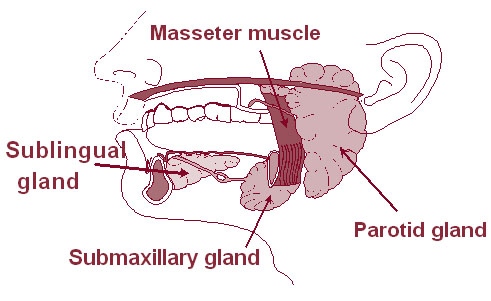
The glands are found in and around your mouth and throat. We call the major salivary glands the parotid, submandibular, and sublingual glands.  They all secrete saliva into your mouth, the parotid through tubes that drain saliva, called salivary ducts, near your upper teeth, submandibular under your tongue, and the sublingual through many ducts in the floor of your mouth.  Besides these glands, there are many tiny glands called minor salivary glands located in your lips, inner cheek area (buccal mucosa), and extensively in other linings of your mouth and throat. Salivary glands produce the saliva used to moisten your mouth, initiate digestion, and help protect your teeth from decay.  As a good health measure, it is important to drink lots of liquids daily. Dehydration is a risk factor for salivary gland disease.

Post38 - Digestive system 3

Mouth

mouth is the first part of the digestive system the foods are pass mouth and then go to another part of the body the mouth can fragment the foods digestive process begin to start
the mouth closure by : lips , species , tongue and palate The space between palate and tongue is oral Cavity

some add
 

The cavity of the mouth is placed at the commencement of the digestive tube it is a nearly oval-shaped cavity which consists of two parts: an outer, smaller portion, the vestibule, and an inner, larger part, the mouth cavity proper.   The Vestibule (vestibulum oris) is a slit-like space, bounded externally by the lips and cheeks; internally by the gums and teeth. It communicates with the surface of the body by the rima or orifice of the mouth. Above and below, it is limited by the reflection of the mucous membrane from the lips and cheeks to the gum covering the upper and lower alveolar arch respectively. It receives the secretion from the parotid salivary glands, and communicates, when the jaws are closed, with the mouth cavity proper by an aperture on either side behind the wisdom teeth, and by narrow clefts between opposing teeth.   The Mouth Cavity Proper (cavum oris proprium) is bounded laterally and in front by the alveolar arches with their contained teeth; behind, it communicates with the pharynx by a constricted aperture termed the isthmus faucium. It is roofed in by the hard and soft palates, while the greater part of the floor is formed by the tongue, the remainder by the reflection of the mucous membrane from the sides and under surface of the tongue to the gum lining the inner aspect of the mandible. It receives the secretion from the submaxillary and sublingual salivary glands.   Structure.—The mucous membrane lining the mouth is continuous with the integument at the free margin of the lips, and with the mucous lining of the pharynx behind; it is of a rosepink tinge during life, and very thick where it overlies the hard parts bounding the cavity. It is covered by stratified squamous epithelium.   The Lips (labia oris), the two fleshy folds which surround the rima or orifice of the mouth, are formed externally of integument and internally of mucous membrane, between which are found the Orbicularis oris muscle, the labial vessels, some nerves, areolar tissue, and fat, and numerous small labial glands. The inner surface of each lip is connected in the middle line to the corresponding gum by a fold of mucous membrane, the frenulum—the upper being the large.

Post37 - Digestive system 2

Auxiliary organs
At first I say the parts of the digestive system & now I just want to add some another organ that helps them the auxiliary organs of the digestive system
:
Salivary glands


Liver


Gallbladder


the liver and gallbladder get together like it


Pancreas


and they again get together in this form :


Post36 - Digestive system 1

The digestive system formed by alimen tary Canal that begin of mouth from anus
also this system have several organ that they release some discharge to the digestive tract
this system formed by
:
Mouth


Throat


Esophagus


Stomach


Small intestine


Colon

they get together in this form: